|
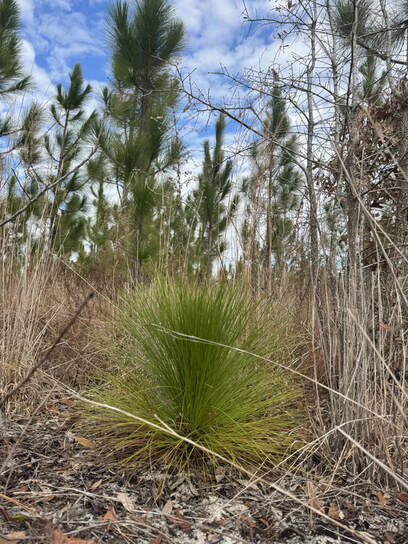
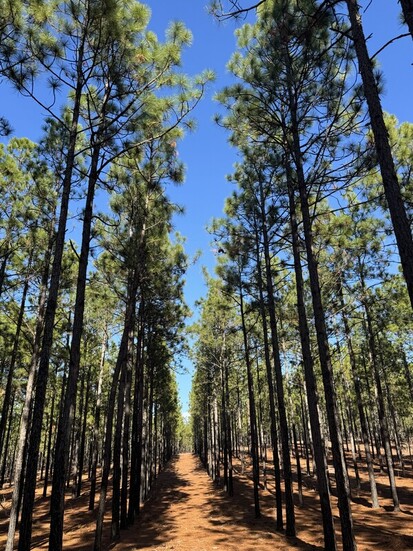
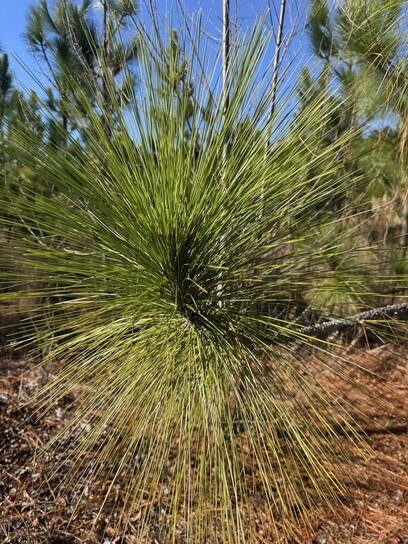
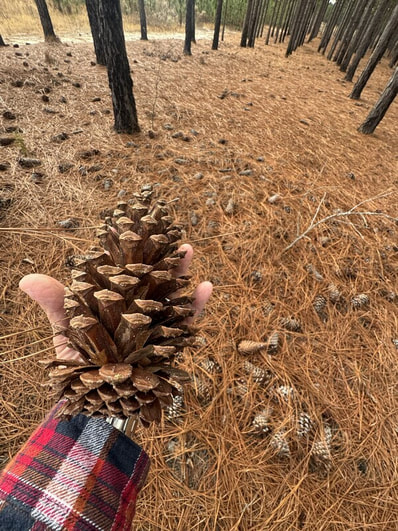
The front 35 acres were planted in 2018 and continue to develop under longleaf pine management. These photos & videos document the progression of the younger stand from initial establishment in 2018 through ongoing stewardship and prescribed fire management. 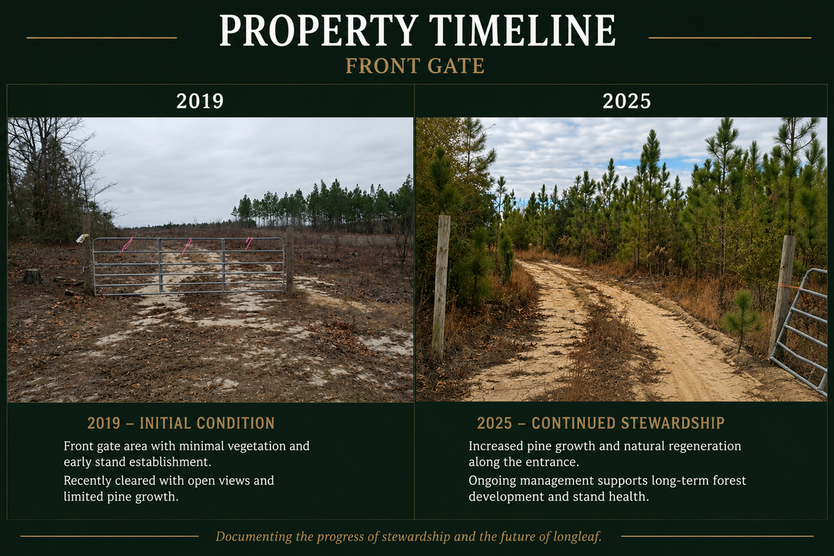 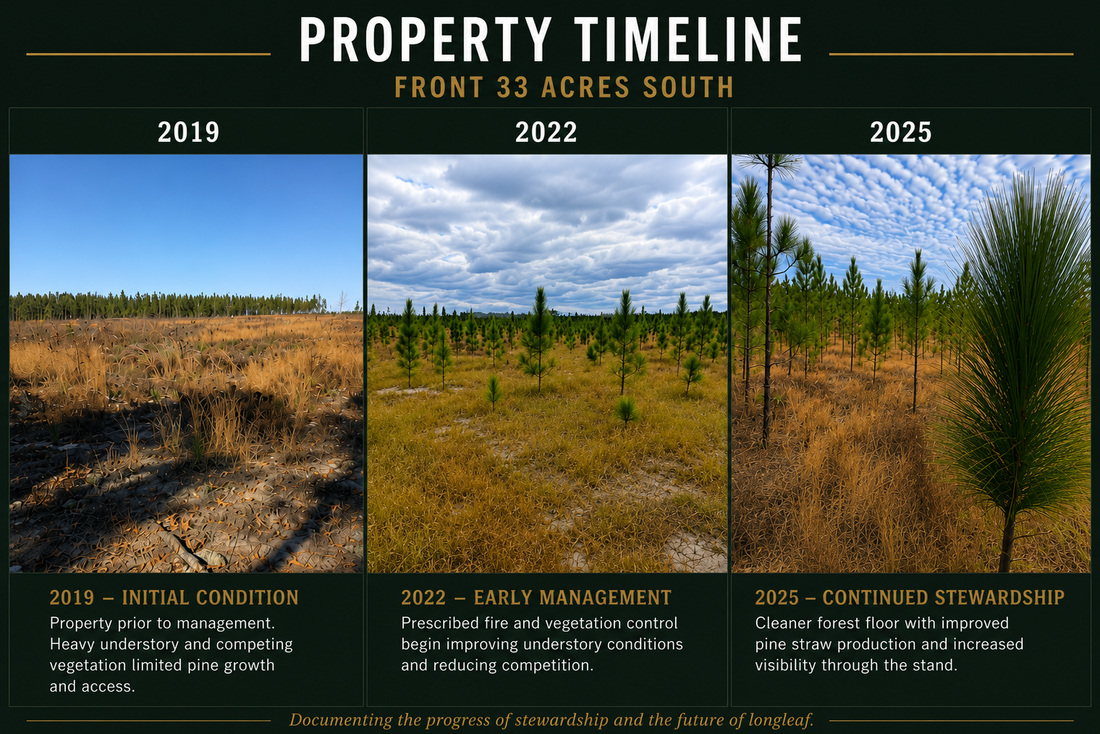 These clips are walking through the timeline of the south 33 acres in December 2025. 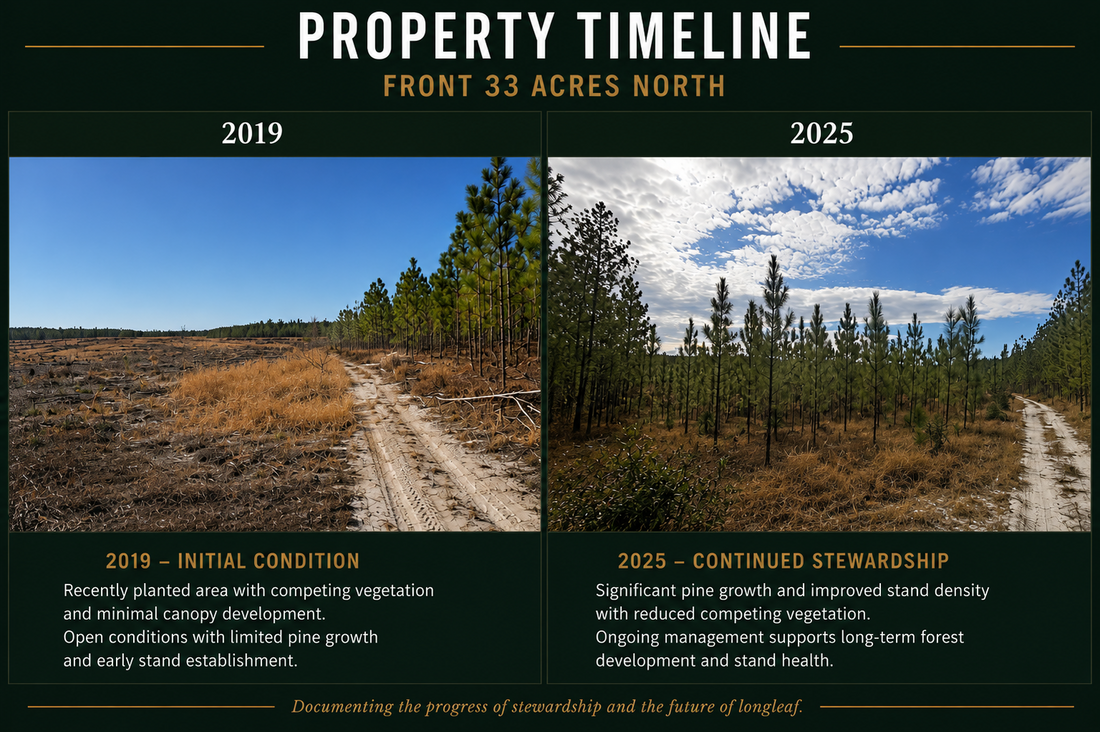 These next three clips are walking through the north side of the front 33 acres. 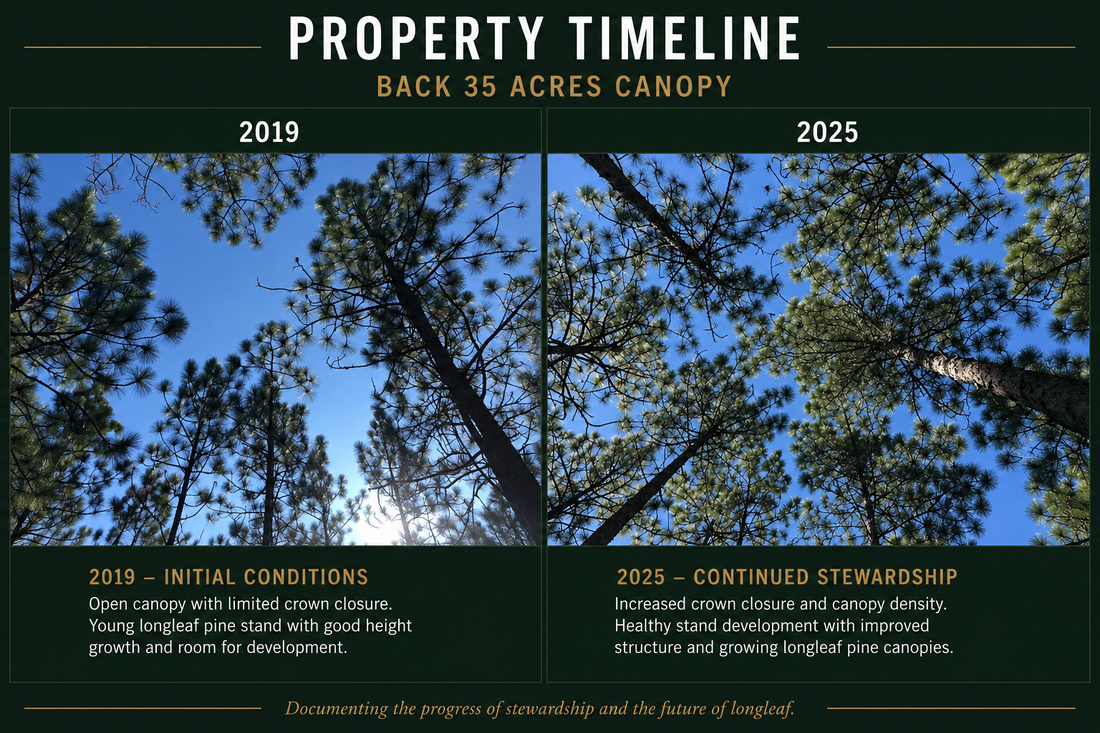 These clips are walking under the canopies in December 2025. The last clip shows the walk down the road that runs through the center of the back 35 acres. Here are some other candid shots from the December 2025 visit.
In Summary:
2019 — Initial Conditions Recently planted stand with competing vegetation and minimal canopy development. 2022 — Early Management Following prescribed fire and vegetation management, the younger stand began establishing more consistently and the older stand Pine straw harvest improved. 2025 — Continued Stewardship Visibility, spacing, and stand structure continue improving as the younger longleaf develops while the older longleaf continue to produce strong yields.
0 Comments
You may remember the original vision for Ride The Pine Tree Farm:
Find 40–80 acres of recreational land that would appreciate over time while eventually producing a moderate annual income. At first glance, the property appeared to check those boxes fairly quickly.
That last part, however, required more work than expected. Early discussions around the property’s pine straw production were vague. Specific annual production numbers were difficult to obtain. The best answer we consistently received was simply: “It produces annual revenue.” At the time of purchase, only the back 35 acres were mature enough to produce pine straw. The front 33 acres had only been planted in 2018 and were still years away from becoming productive. Still, some income was better than none. Then came the first rake in 2020. To be honest, the initial results were somewhat disappointing. Following the first season, the consulting forester recommended chemical treatment to reduce competing vegetation and invasive species throughout the mature stand. Combined with the initial rake, the goal was to give future production a much cleaner forest floor. Looking back at photos from 2019 — many of which were unfortunately lost during a hard drive failure (use cloud storage, people) — the difference becomes obvious. The understory contained significantly more green saplings, brush, and competing vegetation, all of which complicated pine straw harvesting. The treatment plan worked. By the second rake, production had improved enough to cover the property’s annual obligations — although every property and financing structure will vary. That topic deserves its own future post. Fast forward to December 2025, just prior to the seventh rake in January 2026, and the forest floor looked dramatically different. A second chemical treatment had been completed, and the mature stand had become substantially cleaner and more productive for pine straw operations. Looking ahead, continued management will remain important. Chemical treatments will likely continue as needed to control competing vegetation and maintain straw production. Annual raking operations will continue on the mature acreage as well. Meanwhile, the younger 33-acre stand planted in 2018 is still years away from pine straw production. Before that happens, the stand will eventually require thinning — likely sometime around the 15–18 year mark. Typical thinning operations remove selected rows and underperforming trees in order to provide the strongest trees with more sunlight, water, and nutrients. Early thinning revenue is usually generated from pulpwood, generally consisting of trees measuring roughly 5–7 inches diameter at breast height (DBH). In the meantime, prescribed fire will continue to play a major role in managing the younger stand. The first prescribed burn occurred in 2022, and future burns will likely continue on roughly a 3–4 year cycle. Longleaf pine ecosystems evolved alongside fire, and several government programs currently exist to help support prescribed burning efforts — another topic worthy of its own discussion later on. An added benefit of the prescribed burn program has been the establishment and maintenance of fire breaks throughout the property. While their primary purpose is to safely control and contain prescribed burns, the breaks also serve as functional internal roads that improve access for property inspections, wildlife observation, equipment movement, and future management activities. Most recently, with the assistance of my consulting forester, negotiations have begun to increase pine straw revenue on the mature acreage. Several factors influence those discussions, including straw demand, labor availability, and broader timber commodity markets. For the “too long; didn’t read” crowd, here’s the current 10-year outlook:
The journey to owning a 68-acre parcel of longleaf pine began with a desire to own recreational property — but also with the need to justify such a significant purchase.
That justification was not purely financial, although investment potential certainly played an important role. The value also came from the opportunity to enjoy and improve the land, develop wildlife habitat, diversify beyond a traditional 401(k), and ultimately leave a legacy. Over time, the vision evolved into a simple mission: Find 40–80 acres of recreational land that would appreciate over time while eventually producing a moderate annual income. The plan started by narrowing the search to properties within roughly two hours of home that were already established in southern pine. The wish list included water access — whether natural, well, or municipal — along with hunting potential, shooting areas, internal roads, electricity access, and locations suitable for camping or future structures. Research quickly became a major part of the process. More than 40 properties were studied online and tracked by county, location, acreage, and price. In the end, however, only three properties were actually visited in person. Each property was evaluated against the original mission and wish list. The first property lacked internal roads and contained low-lying flood-prone areas. While it was not a bad parcel, it would have required substantial work to turn the vision into reality. The second property lacked sufficient timber, had an awkward layout, and ultimately did not fit the long-term goals for the project. Then came the third property. Sixty-eight acres of longleaf pine. The property stood out immediately. It featured established internal roads from previous timber operations, easy county road access, and approximately half the acreage was already 27 years old and producing pine straw. The remaining acreage had been replanted only a year earlier. Electricity was available at the road, and the property offered the potential to ride ATVs, hunt, shoot, and eventually build a shelter or cabin. It checked nearly every box. So why document the journey? Because the process took years. Understanding land values, forestry terminology, wildlife habitat, pine straw economics, financing, timber management, and property selection required countless hours of research across books, online resources, YouTube videos, maps, and conversations with local experts. The information existed, but it was scattered. My hope is that this journal can help simplify the process for others interested in southern pine land ownership. I do not pretend to have all the answers, and every property journey is different. Instead, I hope these experiences can provide a starting point, spark new ideas, or simply help others feel more confident beginning their own journey. In many ways, documenting the process has become part of the legacy itself. The question is: What will yours be? |
 RSS Feed